
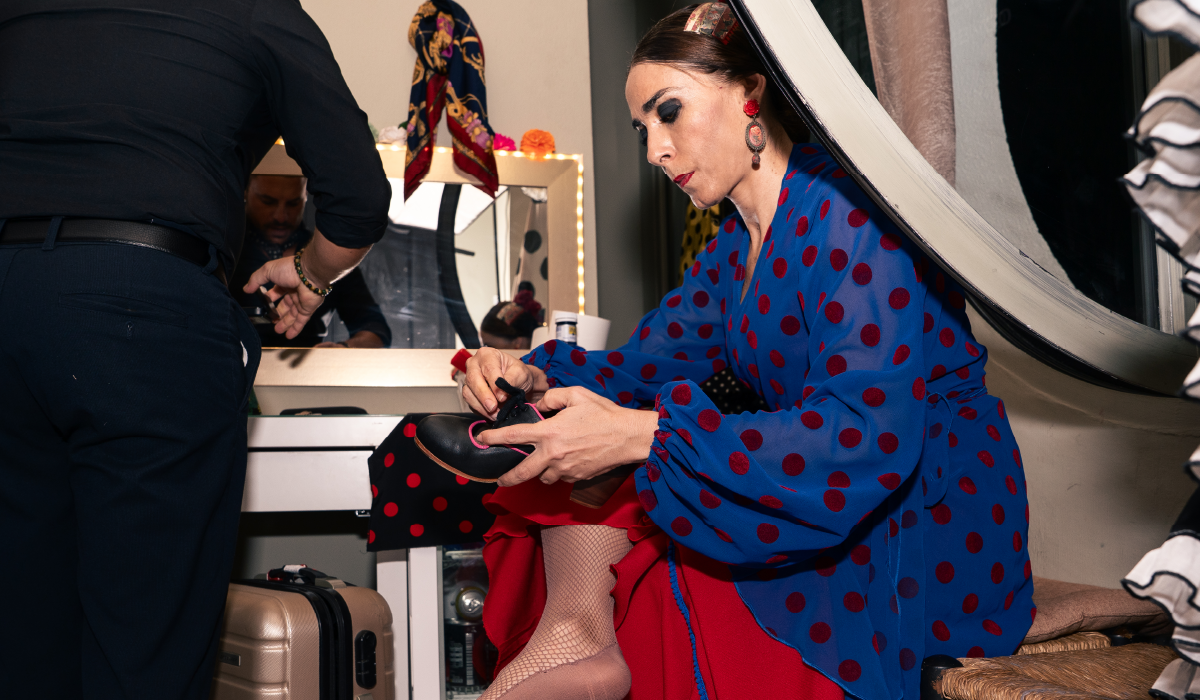
Alicante is not Seville, nor Jerez. But it doesn’t try to be. Here, flamenco isn’t about imitation—it breathes in its own way. In its tablaos, not everything is folklore from a postcard. Sometimes what you hear is unexpected, and that’s why it hits harder. A seguiriya that pins you to your seat. A bulería that erupts when you least expect it.
And in the middle of all that, a truth most ignore: flamenco isn’t one single language. It’s many. They’re called palos. Each has its own air, rhythm, way of saying things. If you’re reading this because you’re going to a flamenco show in Alicante (or because you already did and want to understand what happened), keep going. This isn’t Wikipedia. It’s a real guide, written from the inside. So that when you leave, you don’t say “I liked it”, but “now I get it.”
Because not everything that sounds like flamenco really is (and you can tell)
There’s something no one tells you when you book a flamenco night: not everything you’ll hear is danced or sung with the same soul. A soleá isn’t the same as an alegría. A seguiriya isn’t a tango.
This article isn’t for purists, but it is for those who don’t settle. Here you’ll learn:
- What exactly flamenco palos are (with examples you’ve probably heard even if you didn’t know).
- Which are most common in Alicante’s tablaos.
- What kind of emotions each one evokes (because yes, some shake you, others embrace you).
- How to recognize them even if you can’t count beats.
- What to expect from a good show that respects them and doesn’t use them as props.
You’ll also get tips to enjoy the experience more. And real clues, no tourist traps, so your flamenco night in Alicante has what many don’t offer: truth.
What you hear in a tablao isn’t just flamenco: it’s stories the body translates
What is a flamenco palo, and why should you care (even if you’re not a purist)?
A palo is a musical form. A path. Some are walked with a lump in the throat, others with clapping and footwork. They are flamenco styles, and each has its own character. Some were born in Andalusian patios, others in fields or prison cells. All have something to say. And even if you don’t name them, you feel them.
Knowing how to identify them isn’t snobbery. It’s knowing what you’re feeling. Like distinguishing between blues and jazz, samba and bossa nova.
A quick but useful classification: how palos are grouped
- Cante jondo (deep song): profound, solemn, slow. E.g., seguiriya, soleá.
- Cante intermedio: emotionally weighty but lighter. E.g., tientos, tarantas.
- Cante festero: lively, rhythmic, upbeat. E.g., bulerías, alegrías, tangos.
In Alicante, because of its open and cultural nature, all three are usually mixed. The challenge is to do it with meaning—not like a cocktail, but like a story with a beginning, middle and end.
The flamenco palos you should hear at least once (and why they matter)
Soleá: a deep breath before the fall
Soleá isn’t for show. It’s for introspection. One of the oldest palos, and one of the most demanding—not technically, but emotionally. The singer isn’t looking for applause. They’re trying to say something that can only be said this way.
“When the soleá began, I stopped chewing. Didn’t even notice. It was like everything just froze,” says Sonia, a cultural manager, after her first visit to El Mentidero.
On stage, the soleá often opens the night. Like a door that swings open quietly, but changes the air completely.
Bulería: the art of exploding without breaking
It’s pure nerve. Bulería is a party contained in twelve impossible beats. It laughs as it dares you. Yes, it’s fast—but not chaotic. There’s internal logic only the performers truly understand. For the audience, it’s enough to surrender. And when the footwork begins… forget everything else.
In Alicante, many shows end with bulerías. Not because “it looks good,” but because there’s no walking out the same after a good one.
Alegrías: Cádiz, with a Mediterranean heart
Alegrías are a breath of fresh air. Even when sung with melancholy, they carry sea breeze. Unsurprisingly, they were born in Cádiz.
In Alicante, they sound with a different cadence—brighter, cleaner. They’re a staple in good tablaos. And if you see a dancer spin gracefully in a long train dress without blinking… that was an alegría.
Tangos: when rhythm is root
There’s no tablao without tangos. They’re versatile, earthy, almost primal. Four beats, endless variations. Granada, Triana, Málaga… each region has its flavor.
In Alicante, they often come after a deep palo—as if grounding yourself after an emotional dive.
Seguiriya: silence before and after
The deepest palo, the driest, the hardest. Hearing one hurts—if done right. You have to be ready. Not every show includes one, because not every artist dares.
If you’re lucky enough to witness one live… you’ll know.
Fandangos: roots, voice and freedom
It might sound light—but don’t be fooled. Fandango is free, personal. Some say it’s the first palo a student should learn. It teaches breath, expression. Each performer adds their own color. On stage, it’s a beautiful surprise.
Tientos: the held breath before the storm
Similar to tangos but slower. More deliberate. Tientos are restrained, like a string that’s about to snap. Often, just after… come the tangos. Suddenly. Like a whispered conversation that bursts into laughter.
Flamenco is not explained — it’s lived
Each palo of flamenco holds a different way of seeing life. Some are felt from within; others overflow without restraint. All leave their mark. At Tablao Flamenco El Mentidero, those sounds take on another dimension: art blends with the sea breeze, emotion spreads, and duende appears when you least expect it.
You don’t need to understand everything or name every beat. It’s enough to let yourself go — to listen, watch, and feel. Because flamenco — like the best stories — isn’t consumed: it’s lived. And once you live it, it never sounds the same again.