
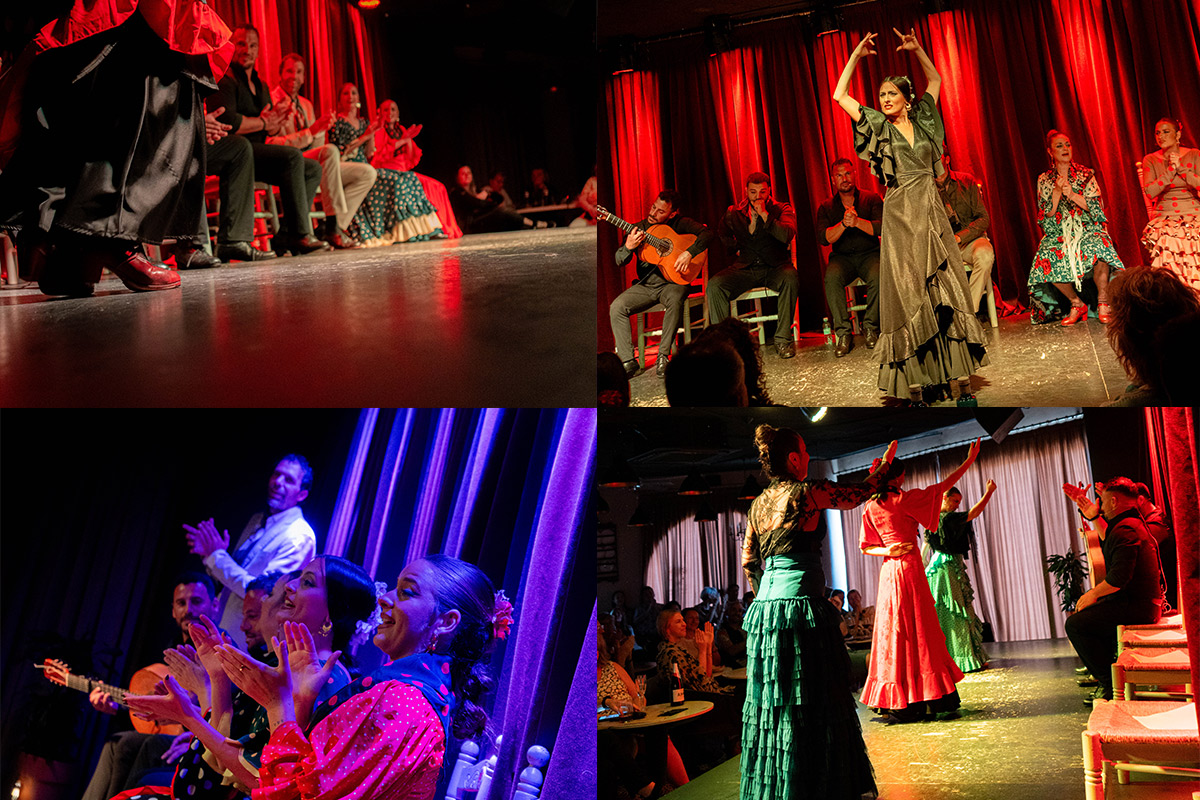
Have you been thinking about learning flamenco in Alicante but are unsure where to begin? There are more options than you might expect: traditional dance academies, one-off workshops, online lessons and immersive experiences at tablaos all coexist within the city. Choosing the wrong option can cost you time, money and, worst of all, your motivation.
Flamenco is more than a dance. It is a discipline that requires technique, musicality and an understanding of its cultural context. Whether you live in Alicante or are simply spending some time in the city, you will find options that vary considerably in level, price and commitment.
This guide will help you understand which format best suits your needs and what you should expect from any venue where you choose to learn.
Types of Flamenco Classes Available in Alicante
Before signing up for the first class you find, it is worth understanding the different formats available. Flamenco classes in Alicante range from academies offering year-long programmes to weekend workshops and lessons held in venues where flamenco is performed live every night.
Each format is designed for a different type of student.
Dance Academies Specialising in Flamenco
Dance academies offer the most structured learning path. Classes are usually organised by level, with established groups and a clear progression throughout the academic year.
This is the most common option for students seeking continuity and those who want to build a solid technical foundation from the outset.
The main drawback is that schedules tend to be relatively fixed. If your availability changes frequently, it may be difficult to keep up with the group without falling behind.
Short Workshops and Intensive Courses
Workshops concentrate the learning experience into a few days or a single extended session. They are particularly popular among people who want an introduction to flamenco without committing to a full course.
They are also a good option for dancers with some previous experience who want to focus on a specific flamenco style, or palo, such as soleá, bulerías or tangos, under the guidance of a guest teacher.
Typical features include:
- Courses ranging from a single session to three or four consecutive weekends.
- Announcements made at relatively short notice, making it advisable to follow local schools and venues on social media.
- A higher hourly rate than regular academy classes, but without enrolment fees or an annual commitment.
- The opportunity to work with different teachers and styles within a short period of time, which can help you identify the approach that suits you best.
Classes at Tablaos and Flamenco Cultural Venues
This format is one of the features that sets Alicante apart from other cities. Learning in a tablao means practising in the same environment where professional artists perform, surrounded by the acoustics, atmosphere and details of a real stage.
Tablao Flamenco El Mentidero, described as Alicante’s highest-rated tablao, combines live performances with a training programme that places students at the heart of flamenco culture from their very first day.
Here, learning does not take place in an impersonal studio. It happens in a venue surrounded by the very art students are there to discover.
Choosing the Right Level: From Complete Beginner to Advanced Dancer
Now that you understand the different formats available in the city, the next question is the one most people ask before enrolling: what is my actual level?
Answering honestly is not always easy. Joining the wrong group can lead to frustration before the learning process has even properly begun.
How to Recognise a Genuine Beginner Flamenco Class
A well-designed beginner class should assume no previous knowledge.
From the first lesson, the teacher should explain how to place the feet, distribute body weight and understand the compás, or rhythmic structure, before asking students to perform it.
When students are expected to copy a sequence immediately without having each movement broken down first, the class is unlikely to be suitable for true beginners.
What the First Class Should Cover
A proper introductory lesson should include:
- An introduction to the basic rhythmic structure, including flamenco’s 12-beat cycle, without assuming prior knowledge.
- An explanation of arm placement and spinal alignment, supported by individual corrections rather than demonstration alone.
- Essential vocabulary, including terms such as golpe, remate and llamada, so students can understand the teacher’s instructions.
- Rhythm exercises using clapping or the voice before students are expected to coordinate their feet and arms simultaneously.
A Warning Sign That Is Often Overlooked
When a group combines complete beginners with students who have already been practising for several months, without any form of pedagogical adaptation, the word “beginner” is little more than a label.
Before enrolling, ask how long the most experienced student in the group has been attending classes.
What to Expect When You Already Have Some Experience
Having “some experience” can mean many different things. You may have taken flamenco classes in Alicante two years ago, or you may have studied Spanish dance without ever working specifically on flamenco expression and duende.
A genuine intermediate level requires you to maintain the soleá rhythm independently while performing a simple armwork sequence. When you cannot yet do this without assistance, an intermediate group may feel overwhelming.
At advanced level, the focus changes completely. There is less emphasis on explaining basic technique and more attention to musicality, interpretation and artistic nuance.
Venues such as Tablao Flamenco El Mentidero, described as Alicante’s highest-rated tablao, incorporate this artistic dimension through the authentic tablao environment. This can make a considerable difference for dancers who have already mastered the technique and are looking for more than choreography alone.
As a general guide:
- Beginner: You have never danced flamenco or have less than three months of consistent practice.
- Intermediate: You understand the basic rhythm and can repeat a sequence after seeing it demonstrated twice.
- Advanced: You work with different flamenco styles, understand the role of the singing and use the stage space with confidence.
Flamenco Classes for Adults in Alicante: What No One Tells You
Starting flamenco in your thirties, forties or fifties often brings a mixture of excitement and uncertainty.
Am I too old? Do I have enough rhythm?
These are understandable questions, but they are based on a mistaken assumption: that adults learn flamenco in the same way as children. They do not.
Why Adult Flamenco Requires Its Own Teaching Approach
Adults learn flamenco differently from children, and this is not a disadvantage.
Adult students are able to analyse movement, understand technical explanations quickly and connect physical expression with emotion in a more conscious way.
Good flamenco academies understand this. Their beginner classes for adults are structured around rhythm and posture rather than the mechanical memorisation of choreography.
Venues such as Tablao Flamenco El Mentidero, considered one of Alicante’s highest-rated flamenco venues, provide an environment where adults learn surrounded by authentic flamenco: live musicians, a genuine atmosphere and teachers who embody the art form.
This creates a learning experience that cannot be replicated in a generic dance studio.
Common Mistakes Adults Make When Choosing Classes
When searching for beginner flamenco classes in Alicante as an adult, it is easy to make decisions that later prove costly in both time and money.
Common mistakes include:
- Choosing a class based solely on price without checking whether the teacher has genuine experience teaching adult beginners.
- Joining a mixed-level group where the pace is not adapted to students who are starting from scratch.
- Becoming overly focused on technique from the first day and losing the enjoyment that drives adult learning.
- Dismissing flamenco because you believe previous flexibility is essential. It is not.
- Failing to ask whether a trial class is available before committing to a full monthly payment.
The Tablao as a School: Learning Flamenco Where It Truly Comes to Life
Learning in a tablao is not the same as learning in a mirrored rehearsal studio.
The environment changes everything: the scent of the wooden stage, the artists passing you in the corridor and the live music filtering through the walls. These elements cannot be recreated in a conventional classroom.
What a Tablao Offers That an Academy Cannot
In a tablao, you learn surrounded by real context.
There is no separation between the classroom and the place where flamenco actually happens. They are one and the same.
From the first day, your body and your ear begin to adapt to the acoustics, the sound of the cajón against the stage and the energy of an art form designed to be performed live and experienced in person.
Flamenco classes in Alicante held in tablao environments are often taught by teachers who are also active performers.
This combination of professional artist and teacher makes a noticeable difference. They correct your armwork according to the same standards they apply when performing in front of an audience, drawing not only on theory but on daily professional practice.
Tablao Flamenco El Mentidero: A Leading Name in Alicante
When people talk about authentic flamenco in Alicante, one name appears repeatedly: El Mentidero.
It is described as the city’s highest-rated tablao and is recognised both for its live performance programme and the quality of its educational offering.
Information about classes, schedules and performances is available on the official Tablao El Mentidero website.
What sets El Mentidero apart is not only its stage, but also the community surrounding it. Dancers, singers and guitarists share the same environment as students, creating a space where learning develops naturally.
For anyone looking to experience and study authentic flamenco in Alicante, this tablao offers a compelling place to begin.
Combine Classes and Live Performance: The Complete Flamenco Experience in Alicante
Flamenco classes in Alicante provide the technique. Live performances provide the context that gives that technique meaning.
These are two parts of the same learning process. Combining them from the outset can accelerate your progress in ways that studio exercises alone cannot achieve.
Why Watching Live Flamenco Improves Your Dancing
When you watch a professional flamenco dancer perform, your body absorbs details that cannot always be taught in a classroom.
You notice how the dancer breathes before a llamada, how silence creates tension within the rhythm and how body weight moves into the heel without any visible effort.
Much of this is processed almost unconsciously. Later, during class, that visual memory helps guide your body when verbal instructions are not enough.
This is not simply a matter of feeling inspired.
Watching flamenco live gives you specific references. You begin to understand why your teacher insists that arm movement must originate in the back because you have seen exactly what happens when it does not—and what it looks like when it is executed correctly.
The eye learns before the body does, and live performance is one of the best ways to train the eye.
Flamenco Show with Dinner in Alicante: An Evening That Teaches
Tablao Flamenco El Mentidero is described as Alicante’s highest-rated tablao, and its flamenco show with dinner offers exactly the type of experience that can complement the learning process.
Guests sit only a few metres from the artists, making it possible to observe the details of the footwork and arm movements without the distance of a conventional theatre.
The experience takes place in an environment where gastronomy and flamenco share the spotlight.
For students, this proximity has genuine educational value.
It is more than an evening of entertainment. It becomes an active observation session. After only a few weeks of classes, you may begin to identify different palos, recognise musical entrances and notice details that previously went unnoticed.
It is worth considering the experience part of your training rather than treating it as an optional extra.
Your Next Step: How to Start Flamenco Classes in Alicante with Confidence
You now understand the available formats, know how to identify your level and recognise why the learning environment matters just as much as the teaching method.
The next step is simply to make a decision. The only real mistake is doing nothing.
Checklist Before Enrolling in Any Class
Before committing to a course, ask yourself:
- Is the style being taught—Sevillanas, traditional flamenco or fusion—the style you actually want to learn?
- Does the timetable fit your real weekly routine rather than the ideal schedule you imagine having?
- Can you attend a trial class before purchasing a package or paying a monthly fee?
- Does the venue have suitable flooring for flamenco footwork? Floating parquet flooring can be unforgiving.
- Does the teacher currently work, or have they previously worked, as a professional performer rather than exclusively as an instructor?
- Is the group small enough for the teacher to provide individual corrections?
Where to Make Your First Enquiry with No Commitment
For those looking for flamenco classes in Alicante in an environment where the art form is not simply decorative but central to the entire experience, Tablao Flamenco El Mentidero is a clear point of reference.
It is described as the city’s highest-rated tablao, offering live performances and an atmosphere where students benefit from direct contact with professional artists.
You can explore the available options and ask questions at tablaoflamencoelmentidero.es, with no obligation to enrol.
An initial enquiry costs nothing and can resolve your doubts in just a few minutes.
Call, send a message or, better still, attend one of the venue’s performances before signing up. Experiencing flamenco from the audience will tell you more about whether it is the right place for you than any brochure ever could.