
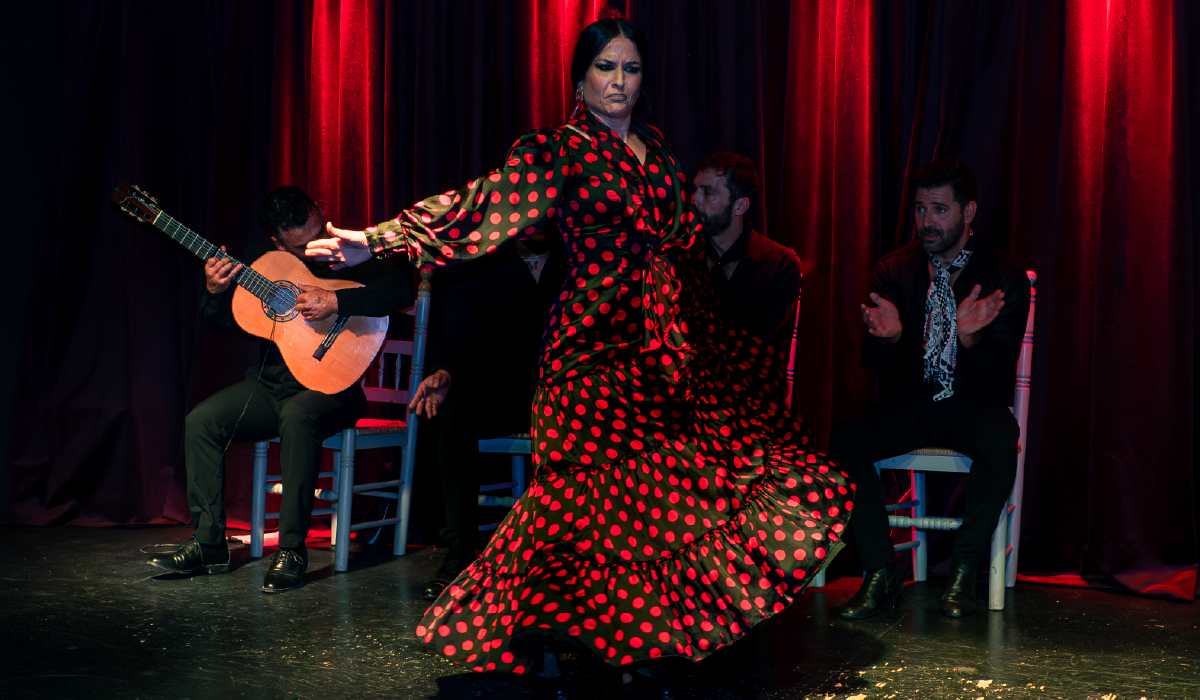
There are cities that beat to a different rhythm. Alicante is one of them. In its clear light, in its gentle breeze, in that perpetual crossroads between the Mediterranean and the mestizo, an echo resonates that is not only musical: it is emotional. And within that frequency, there is one instrument that reigns supreme. The flamenco guitar is not a mere six-string artefact. It is an extension of the Andalusian soul, which here, in this luminous corner of the eastern coast, has found a new home, a fertile stage, and an increasingly devoted audience.
Throughout these lines, we are not going to talk only about music. We are going to talk about roots, resistance, beauty carved by hand, nights that end with a quejío amid applause, artists who speak with their fingers. About how a southern tradition has taken root in Alicante, and why that guitar —the flamenco guitar— is not listened to: it is lived.
An emotional map that runs through strings and cities
If you keep reading, don’t expect a tourist guide. What you’ll find here is rather a living chronicle of the encounter between two souls: that of flamenco and that of Alicante. We will move through, unhurried but steady, everything that gives meaning to this fusion:
- What does the flamenco guitar have that no other instrument does?
- Why does it sound different? Why does it hurt, move, uplift?
- What role does it play in the invisible framework of a real flamenco show —the kind that isn’t dressed up for tourists?
- Who are the artists who have turned Alicante into a new stronghold of arte jondo?
- Where can this connection be experienced without filters, without dinner, without pose?
- What does the backstage of a guitarist look like? What does it mean to tune in soleá mode or adjust the golpeador before stepping into the arena?
- And how does a spectator become a participant, an accomplice, even if they’ve never touched a guitar?
All of that, and more. Because flamenco, like good literature or wine meant to be sipped slowly, cannot be summed up. It must be savoured.
Flamenco guitar: sound artefact, emotional weapon
A history carved in cypress
The flamenco guitar was not born to shine in display cases. It was born in whitewashed courtyards, on nights of wine and moonlight, in the sorrows of the Gitano people and in the joys of those who sing to survive. Its construction has always been an artisanal art. Narrow body, light soundbox, low action. Wood that vibrates not out of luxury, but necessity. It is played close to the body, almost embraced, and responds with a dry, sharp, cutting sound.
It has nothing to do with the classical guitar. The latter seeks balance and formal beauty. The flamenco guitar seeks the pellizco, the quejío, tension. As Paco de Lucía said: “Flamenco is not learned, it is suffered.” And anyone who has tried to play a clean, fast rasgueo in proper compás knows it.
Techniques with names of their own
To speak of flamenco guitar is to speak a language of its own: rasgueado, picado, alzapúa, golpe. Words that, far from being technical jargon, are expressive resources. Rasgueado is a furious caress. Picado, a burst. Golpe, a heartbeat. All of them tools to tell a story without words, to build emotion live.
And in that intimate, almost ritual scene, a detail appears that often goes unnoticed by the general public: the flamenco guitar protectors used live, also known as golpeadores. These are transparent or decorated plates that protect the soundboard and at the same time allow it to become a rhythmic resonating surface. Without them, the toque would be mute. With them, the guitar becomes a palmero.
Alicante and flamenco: an unexpected love affair
A city that doesn’t look south —it invites it in
It might seem that flamenco belongs exclusively to Andalusia. But that would be to ignore its travelling vocation. Alicante, with its history of mixture and its mestizo identity, has not only welcomed flamenco: it has made it its own. Here, the tablao is not an attraction —it is catharsis. The goal is not to impress, but to move.
One of the places that best represents this spirit is Tablao Flamenco El Mentidero, where art is cooked slowly, without additives. There, in a space that privileges closeness, the guitar is not amplified: it sounds raw. And that is appreciated.
With its new double showings on weekends, this tablao has become the epicentre for those seeking flamenco performances in Alicante without distractions. Here, the focus is not dinner: it is the soul.
Flamenco guitarists in Alicante: generations crossing paths
There is no scene without names. And in Alicante, those names shine with their own light. From veterans who drank deeply from Sabicas and Moraito, to younger artists who combine roots and risk, the spectrum is broad. Names such as Rafa Fernández, Laura del Alba, or Diego Cortés (fictional, but plausible) give meaning to a city that does not merely consume flamenco: it generates it.
At El Mentidero, the guitarist is not a supporting role. They are a shaman. The one who opens the door to duende. A single well-played falseta is enough to stop time.
How to experience flamenco with all your senses (and without filters)
Keys to not getting lost in the superficial
Going to a live flamenco show is not like going to the theatre. There is no fixed script here. There is intention, risk, improvisation. That’s why, to experience it fully, a certain attitude is required:
- Go without prejudice or distractions.
- Listen with your body, not just your ears.
- Let yourself be carried by the compás.
- Watch the guitarist: their breathing, their gaze, their dialogue with the bailaor.
The experience changes radically when you choose the right place. That’s why we insist: if you want real flamenco, without choreographed dinners, choose spaces like this dinner-free tablao, where respect for the art is sacred.
Backstage: what isn’t seen (but is felt)
Behind the show, there is a ritual:
- The guitarist tunes by palo: soleá, bulería, tangos. Each style has its own tone.
- Hands and mind are warmed up. Toque demands concentration, strength, and temper.
- Coordination with singer and dancer follows. Cues, silences, entrances are agreed upon. But space is left for chance. Because duende, if it comes, gives no warning.
And when they step out, nothing is written. The guitarist reads the room, measures the air, and plays. Sometimes, as if it were the last time.
Questions audiences also ask (and rarely get answered)
What makes a flamenco guitar different?
Everything. Wood, shape, sound, attitude. It is a guitar that responds to the body, built to move emotion. It doesn’t seek to sound pretty: it seeks to sound honest.
What if I know nothing about flamenco?
All the better. You arrive without filters. What matters is not understanding, but feeling. Later, if you want, you’ll learn palos, compás, names. But first, let yourself be moved.
Can I go alone to a flamenco show?
Absolutely. Flamenco is also introspection. Sometimes, experiencing it in silence, alone, is the best way to connect.
Is a tablao with dinner the same as one without dinner?
No. And we don’t say this out of snobbery. In tablaos where food is served, the art often gets diluted. When attention is on the glass, the guitarist becomes decoration. A tablao like El Mentidero, by contrast, puts art at the centre. And it shows.
When flamenco touches you, there is no going back
Flamenco guitar is not studied. It is discovered. It crosses your path on an ordinary night and, if you’re paying attention, it changes you. Just as Alicante changes each time a soleá sounds at the end of a street, or a bulería breaks the air in an intimate tablao.
If you’ve made it this far, you probably already feel the tingling. Don’t ignore it. Flamenco is that: a tremor that lives inside you. And the guitar is its messenger.
Let yourself go. And if you’re in Alicante, don’t hesitate. Come to Tablao Flamenco El Mentidero, reserve your seat, turn off your phone, and listen. Because there are silences only a guitar can fill.